Tensions between the U.S. and Iran have increased amid widespread anti-government protests and a lethal state crackdown, U.S. threats of forceful intervention along with visible military repositioning, and reciprocal warnings from Tehran that explicitly threaten U.S. bases, vessels, and regional partners. This has prompted a series of U.S. embassy alerts, presidential statements signaling potential military action, and a massive deployment of U.S. military assets to the region. While diplomatic channels remain open, the situation risks broader regional instability, including disruptions to oil supplies through the Strait of Hormuz.
Miscalculation: The Real Danger of Unintended War
The immediate risk is not necessarily a deliberate U.S. decision to pursue regime change by force, but rather a miscalculation spiral: domestic violence inside Iran triggers U.S. coercive steps; Iran responds asymmetrically (or credibly threatens to); U.S. force protection and deterrence measures increase; and a localized incident, such as a base or maritime attack, becomes a trigger for wider exchanges. Regional governments appear to be working to de-escalate, but the situation remains fluid.
Coordinated Alerts and Evacuations
On January 14, AlertsUSA subscribers were notified that US embassies in Saudi Arabia, Kuwait, and Qatar issued coordinated warnings advising American citizens and and U.S. government personnel to avoid key installations in their respective countries due to ongoing regional tensions. In Qatar, some U.S. personnel were ordered to evacuate Al Udeid Air Base as a precaution.
Also on January 14th, subscribers were notified of a security alert issued by the US Embassy in Israel urging increased personal security awareness and preparedness for American citizens due to the same regional dynamics. If Iran is attacked, Israel is sure to be targeted in any retaliation.
On January 12, the State Department warned of intensifying protests across Iran, advising all dual U.S.-Iranian citizens to maintain a low profile and depart immediately. The advisory noted Iran's non-recognition of dual nationality, heightening risks of arbitrary detention, and suggested land exits to Armenia or Turkey amid flight cancellations and internet blackouts.
"Help is on the Way"
President Trump has repeatedly indicated potential U.S. military involvement if Iran continues suppressing protests. On January 13th, the President urged protesters to persist, promising that "help is on its way," and canceling meetings with Iranian officials until the killings cease.
One day later, the President noted he had received assurances that executions and killings had stopped, adopting a "wait and see" stance while affirming "all options remain on the table."
Carriers Racing to the Region
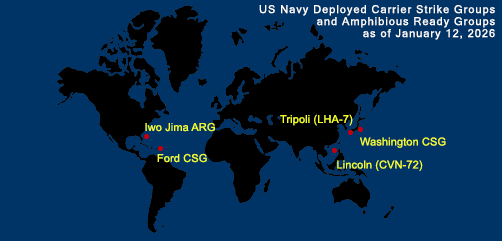
The U.S. continues repositioning assets, including at least two carrier strike groups to the Middle East. The USS Abraham Lincoln (CVN-72), previously in the South China Sea, is transiting to the Arabian Sea and the CENTCOM area of responsibility and is expected to arrive within a week, accompanied by destroyers, submarines, and dozens of aircraft.
Earlier in the week, both the USS George H. W. Bush (CVN-77) and USS Theodore Roosevelt (CVN-71) carrier groups departed Norfolk, Virginia, heading across the Atlantic. Additional air, land, and sea forces—including from several European nations—are flowing in, providing options for strikes or defense against Iranian retaliation.
Tehran Threatens U.S. Bases and Gulf Allies
Iran has warned Gulf neighbors, including Qatar and Saudi Arabia, that U.S. bases on their soil would be targeted if Washington attacks. Senior officials, including IRGC General Mohsen Rezaei, vowed to "cut off" Trump's hand and abandon ceasefires if provoked. Proxy groups like Kata'ib Hezbollah have echoed threats against U.S. interests.
Airspace closures and personnel evacuations underscore fears of imminent conflict. While Arab states urged restraint—helping to de-escalate temporarily—the standoff remains volatile. Protests appear subdued under repression, but renewed violence could trigger U.S. action, risking a wider war.
|