Late Tuesday, the FAA issued a Temporary Flight Restriction (TFR), grounding all flights in and out of El Paso International Airport for what was initially a ten-day period, citing “special security reasons.”
The TFR created a 20-mile-wide cylinder of restricted airspace up to 18,000 feet, centered on the airport and extending into southern New Mexico, including Santa Teresa. It imposed an immediate ground stop on commercial, cargo, general aviation, and select military flights.
Disruptions followed swiftly: at least 14 commercial flights canceled, passengers stranded, and medevac helicopters diverted. Air traffic control advised pilots of the sudden activation, directing carriers to hold or divert.
Six hours later, the FAA lifted the core El Paso TFR, declaring “no threat to commercial aviation.” A parallel restriction over the Potrillo Mountains and deserts to the west remains active through February 20.
Within hours of the incident, the Office of the Under Secretary of War for Research and Engineering posted an image to social media of an American Eagle with a laser firing behind it's head into a swarm of drones, along with the simple message: "Defend the Homeland."
Official vs. Media Accounts of the Threat
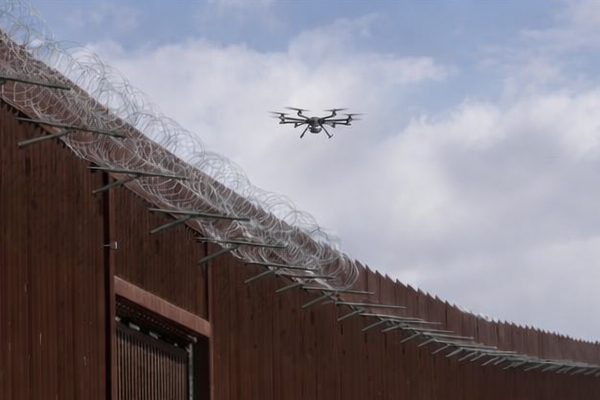
Trump administration officials, led by Transportation Secretary Sean Duffy, attributed the TFR to a Mexican cartel drone incursion neutralized by DoD and CBP assets. Pentagon sources confirmed strikes on UAS from Mexico. AlertsUSA defense sources corroborated multiple border-crossing drones.
Multiple mainstream outlets offered an alternative explanation: the shutdown stemmed from uncoordinated DoD/CBP high-energy laser counter-drone testing near Fort Bliss and Biggs Army Airfield, adjacent to civilian paths.
El Paso’s position on the U.S.-Mexico border, with Fort Bliss as a counter-UAS hub, underscores the escalating cartel drone threat. The event reveals ongoing challenges in synchronizing military operations with FAA civil airspace management.
Iranian Influence as a Launchpad for Asymmetric Strikes
U.S. intelligence and law enforcement professionals are increasingly focused on Iranian influence across Mexico and Latin America as a potential launchpad for asymmetric retaliation against the U.S. homeland in the event of an American strike on the Islamic Republic. This week’s El Paso TFR serves as a timely illustration of the aerial and border vulnerabilities that Tehran and its proxies could exploit.
Iran’s Islamic Revolutionary Guard Corps, particularly its Quds Force, has cultivated deep networks in the Western Hemisphere for decades. Hezbollah, Tehran’s most capable proxy, maintains operational cells in at least a dozen countries from Mexico to Argentina, using the region for financing, logistics, and intelligence collection. Key hubs include Venezuela, where the Maduro regime supplied state protection and passports; the Tri-Border Area of Argentina, Brazil, and Paraguay, a longstanding center of money laundering and recruitment; and Colombia and Mexico, where Hezbollah collaborates with drug cartels on cocaine trafficking and arms smuggling.
Heightened Risks and Doctrinal Realities
U.S. Treasury and Justice Department actions have repeatedly underscored the threat. Hezbollah-linked networks, such as the Ayman Joumaa organization, have laundered hundreds of millions through narcotics and used-car schemes. Congressional testimony and SOUTHCOM assessments paint a consistent picture: IRGC Quds Force operatives embedded in diplomatic missions and diaspora communities, with documented plots involving Mexican cartels.
The risk of asymmetric strikes has sharpened amid escalating tensions. IRGC doctrine favors proxy warfare to avoid direct confrontation. Should Washington launch kinetic operations against Iranian targets, Tehran has threatened to activate global assets—Latin America offering the plausible deniability it craves. Operatives could cross via cartel routes, deploying drones for strikes on infrastructure or communities.
Border security forces, including military elements, now stand at heightened readiness. The southern frontier is no longer merely a theater of migration and narcotics. It has become a potential forward operating base for America’s most patient adversaries. As the Pentagon’s National Defense Strategy warns, the U.S. military must prepare for combat operations from the homeland itself.
|